
 Print
Print
Chemical Datasheet
LITHIUM HYDRIDE |
|
Chemical Identifiers
| CAS Number |
UN/NA Number |
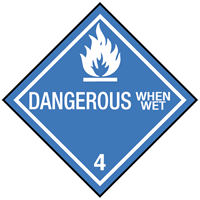
DOT Hazard Label |
USCG CHRIS Code |
|
|
|
|
|
| NIOSH Pocket Guide |
International Chem Safety Card |
|
Lithium hydride
|
|
NFPA 704
General Description
A white or translucent crystalline mass or powder. The commercial product is light bluish-gray lumps due to the presence of minute amounts of colloidally dispersed lithium.
Hazards
Reactivity Alerts
- Strong Reducing Agent
- Water-Reactive
- Pyrophoric
Air & Water Reactions
Burns readily in air, particularly if powdered. May ignite spontaneously in moist air. Reacts rapidly with water to form caustic lithium hydroxide and hydrogen [Bretherick 1979 p. 107].
Fire Hazard
In a fire, irritating alkali fumes may form. Lithium hydride can form airborne dust clouds which may explode on contact with flame, heat, or oxidizing materials. Additionally, spontaneous ignition occurs when nitrous oxide and lithium hydride are mixed. Lithium hydride also forms explosive mixtures with liquid oxygen. Contact with heat, moisture or acid causes exothermic reaction and evolution of hydrogen as well as lithium hydroxide. Incompatible with air and moisture, nitrous oxide, strong oxidizers, and liquid oxygen. Lithium hydride may ignite spontaneously in air and should be maintained and handled out of contact with air and moisture. Any contact with nitrous oxide; airborne powders may ignite upon reaching moisture. (EPA, 1998)
Health Hazard
This material is relatively toxic to people. It is more likely to cause irritation of skin and mucous membrane tissues rather than death. Its effects are primarily acute. A massive exposure to the eyes and by inhalation may be lethal. Those experiencing any ailment of the upper respiratory tract (e.g., bronchitis or pneumonia) are at a greater risk. (EPA, 1998)
Reactivity Profile
LITHIUM HYDRIDE is a strong reducing agent. Th esolid may decompose violently in contact with most oxidizing materials. It reacts exothermically with water to form caustic lithium hydroxide and hydrogen gas; the hydrogen may ignite. May ignite spontaneously in moist air. Mixtures with liquid oxygen are explosive. Ignites on contact with dinitrogen oxide [Mellor, 1967, vol. 8, suppl. 2.2, p. 214].
Belongs to the Following Reactive Group(s)
- Metal Hydrides, Metal Alkyls, Metal Aryls, and Silanes
Potentially Incompatible Absorbents
No information available.
Response Recommendations
Isolation and Evacuation
Excerpt from 138

[Substances - Water-Reactive (Emitting Flammable Gases)]:
IMMEDIATE PRECAUTIONARY MEASURE: Isolate spill or leak area in all directions for at least 50 meters (150 feet) for liquids and at least 25 meters (75 feet) for solids.
SPILL: Increase the immediate precautionary measure distance, in the downwind direction, as necessary.
FIRE: If tank, rail car or tank truck is involved in a fire, ISOLATE for 800 meters (1/2 mile) in all directions; also, consider initial evacuation for 800 meters (1/2 mile) in all directions. (ERG, 2020)
Firefighting
Wear protective goggles or face shield, rubberized gloves, flame-proof outer clothing, respirator, and high boots or shoes. Large fires: withdraw from area and let fire burn, as lithium hydride may continue to re-ignite. A fire, once started, cannot be extinguished by ordinary methods.
Do not use water, carbon dioxide, dry chemical, or halogenated extinguishing agents such as carbon tetrachloride. Use dry graphite; or ground dolomite-based dry chemical extinguishers such as "Lith-X". Fires may be smothered by inverting a can over them. (EPA, 1998)
Non-Fire Response
Excerpt from 138
[Substances - Water-Reactive (Emitting Flammable Gases)]:
ELIMINATE all ignition sources (no smoking, flares, sparks or flames) from immediate area. Do not touch or walk through spilled material. Stop leak if you can do it without risk. Use water spray to reduce vapors or divert vapor cloud drift. Avoid allowing water runoff to contact spilled material. DO NOT GET WATER on spilled substance or inside containers.
SMALL SPILL: Cover with DRY earth, DRY sand or other non-combustible material followed with plastic sheet to minimize spreading or contact with rain. Dike for later disposal; do not apply water unless directed to do so.
POWDER SPILL: Cover powder spill with plastic sheet or tarp to minimize spreading and keep powder dry. DO NOT CLEAN-UP OR DISPOSE OF, EXCEPT UNDER SUPERVISION OF A SPECIALIST. (ERG, 2020)
Protective Clothing
Excerpt from NIOSH Pocket Guide for Lithium hydride:
Skin: PREVENT SKIN CONTACT - Wear appropriate personal protective clothing to prevent skin contact.
Eyes: PREVENT EYE CONTACT - Wear appropriate eye protection to prevent eye contact.
Wash skin: BRUSH (DO NOT WASH) - Brush (DO NOT WASH)
Remove: WHEN WET OR CONTAMINATED - Work clothing that becomes wet or significantly contaminated should be removed and replaced.
Change: DAILY - Workers whose clothing may have become contaminated should change into uncontaminated clothing before leaving the work premises.
Provide:
• EYEWASH - Eyewash fountains should be provided in areas where there is any possibility that workers could be exposed to the substances; this is irrespective of the recommendation involving the wearing of eye protection.
• QUICK DRENCH (>0.5 MG/M3) - Facilities for quickly drenching the body should be provided within the immediate work area for emergency use where there is a possibility of exposure. [Note: It is intended that these facilities provide a sufficient quantity or flow of water to quickly remove the substance from any body areas likely to be exposed. The actual determination of what constitutes an adequate quick drench facility depends on the specific circumstances. In certain instances, a deluge shower should be readily available, whereas in others, the availability of water from a sink or hose could be considered adequate.] (>0.5 mg/m3) (NIOSH, 2023)
DuPont Tychem® Suit Fabrics
No information available.
First Aid
Warning: Lithium hydride is an alkaline-corrosive agent. Contact with eyes may result in severe damage to the cornea, conjunctiva, and blood vessels. Caution is advised.
Signs and Symptoms of Acute Lithium Hydride Exposure: Acute exposure to lithium hydride may result in irritation and burning of the skin, eyes, and mucous membranes. Increased salivation, dysphagia (difficulty swallowing), abdominal pain, and spontaneous vomiting may occur. Stridor (high-pitched, noisy respirations), dyspnea (shortness of breath), and pulmonary edema are also common. Apathy and mental confusion may develop, with progression to coma and death.Emergency Life Support Procedures: Acute exposure to lithium hydride may require decontamination and life support for the victims. Emergency personnel should wear protective clothing appropriate to the type and degree of contamination. Air-purifying or supplied-air respiratory equipment should also be worn, as necessary. Rescue vehicles should carry supplies such as plastic sheeting and disposable plastic bags to assist in preventing spread of contamination.
Inhalation Exposure:
1. Move victims to fresh air. Emergency personnel should avoid self-exposure to lithium hydride.
2. Evaluate vital signs including pulse and respiratory rate, and note any trauma. If no pulse is detected, provide CPR. If not breathing, provide artificial respiration. If breathing is labored, administer oxygen or other respiratory support.
3. Obtain authorization and/or further instructions from the local hospital for administration of an antidote or performance of other invasive procedures.
4. Transport to a health care facility.
Dermal/Eye Exposure:
1. Remove victims from exposure. Emergency personnel should avoid self- exposure to lithium hydride.
2. Evaluate vital signs including pulse and respiratory rate, and note any trauma. If no pulse is detected, provide CPR. If not breathing, provide artificial respiration. If breathing is labored, administer oxygen or other respiratory support.
3. Remove contaminated clothing as soon as possible.
4. If eye exposure has occurred, eyes must be flushed with lukewarm water for at least 30 minutes.
5. Wash exposed skin areas for at least 15 minutes with water.
6. Obtain authorization and/or further instructions from the local hospital for administration of an antidote or performance of other invasive procedures.
7. Transport to a health care facility.
Ingestion Exposure:
1. Evaluate vital signs including pulse and respiratory rate, and note any trauma. If no pulse is detected, provide CPR. If not breathing, provide artificial respiration. If breathing is labored, administer oxygen or other respiratory support.
2. DO NOT induce vomiting or attempt to neutralize!
3. Obtain authorization and/or further instructions from the local hospital for administration of an antidote or performance of other invasive procedures.
4. Activated charcoal is of no value.
5. Give the victims water or milk: children up to 1 year old, 125 mL (4 oz or 1/2 cup); children 1 to 12 years old, 200 mL (6 oz or 3/4 cup); adults, 250 mL (8 oz or 1 cup). Water or milk should be given only if victims are conscious and alert.
6. Transport to a health care facility. (EPA, 1998)
Physical Properties
Flash Point: data unavailable
Lower Explosive Limit (LEL):
Flammable solid.
(EPA, 1998)
Upper Explosive Limit (UEL):
Flammable solid.
(EPA, 1998)
Autoignition Temperature:
392°F
(USCG, 1999)
Melting Point:
1256°F
(EPA, 1998)
Vapor Pressure:
0 mmHg
at 68°F
(EPA, 1998)
Vapor Density (Relative to Air): data unavailable
Specific Gravity:
0.76 to 0.77
(EPA, 1998)
Boiling Point:
Decomposes
(NIOSH, 2023)
Molecular Weight:
7.95
(EPA, 1998)
Water Solubility:
Reacts with water
(NIOSH, 2023)
Ionization Energy/Potential: data unavailable
IDLH:
0.5 mg/m3
(NIOSH, 2023)
AEGLs (Acute Exposure Guideline Levels)
No AEGL information available.
ERPGs (Emergency Response Planning Guidelines)
| Chemical |
ERPG-1 |
ERPG-2 |
ERPG-3 |
| Lithium Hydride (7580-67-8)
|
0.025 mg/m3 |
0.1 mg/m3 |
3 mg/m3 |
(AIHA, 2022)
PACs (Protective Action Criteria)
| Chemical |
PAC-1 |
PAC-2 |
PAC-3 |
| Lithium hydride (7580-67-8)
|
0.025 mg/m3 |
0.1 mg/m3 |
0.5 mg/m3 |
(DOE, 2018)
Regulatory Information
EPA Consolidated List of Lists
| Regulatory Name |
CAS Number/
313 Category Code |
EPCRA 302
EHS TPQ |
EPCRA 304
EHS RQ |
CERCLA RQ |
EPCRA 313
TRI |
RCRA
Code |
CAA 112(r)
RMP TQ |
| Lithium hydride |
7580-67-8 |
100 pounds |
100 pounds |
|
|
|
|
(EPA List of Lists, 2022)
CISA Chemical Facility Anti-Terrorism Standards (CFATS)
No regulatory information available.
OSHA Process Safety Management (PSM) Standard List
No regulatory information available.
Alternate Chemical Names
- LITHIUM HYDRIDE
- LITHIUM HYDRIDE(LIH)
- LITHIUM MONOHYDRIDE
 Health
 Flammability
 Instability
 Special