
 Print
Print
Chemical Datasheet
FLUOROSILICIC ACID |
|
Chemical Identifiers
| CAS Number |
UN/NA Number |
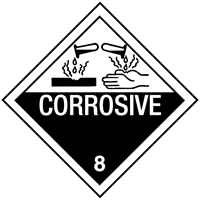
DOT Hazard Label |
USCG CHRIS Code |
|
|
|
|
|
| NIOSH Pocket Guide |
International Chem Safety Card |
|
none
|
|
NFPA 704
data unavailable
General Description
A colorless fuming liquid with a penetrating pungent odor. Corrosive to metals and tissue. Both the fumes and very short contact with the liquid can cause severe and painful burns. Used in water fluoridation, in hardening cement and ceramics, as a wood preservative.
Hazards
Reactivity Alerts
- Known Catalytic Activity
- Water-Reactive
Air & Water Reactions
Fumes in air. Soluble in water with release of heat and corrosive fumes.
Fire Hazard
Special Hazards of Combustion Products: Irritating fumes of hydrogen fluoride may form in fire. (USCG, 1999)
Health Hazard
Inhalation of vapor produces severe corrosive effect on mucous membrane. Ingestion causes severe burns of mouth and stomach. Contact with liquid or vapor causes severe burns of eyes and skin. (USCG, 1999)
Reactivity Profile
FLUOROSILICIC ACID can react with strong acids (such as sulfuric acid) to release fumes of toxic hydrogen fluoride. Attacks glass and materials containing silica. Reacts exothermically with chemical bases (examples: amines, amides, inorganic hydroxides). Reacts with active metals, including iron and aluminum to dissolve the metal and liberate hydrogen and/or toxic gases. Can initiate polymerization in certain alkenes. Reacts with cyanide salts and compounds to release gaseous hydrogen cyanide. Flammable and/or toxic gases are also often generated by reactions with dithiocarbamates, isocyanates, mercaptans, nitrides, nitriles, sulfides, and weak or strong reducing agents. Additional gas-generating reactions may occur with sulfites, nitrites, thiosulfates (to give H2S and SO3), dithionites (SO2), and carbonates. Can catalyze (increase the rate of) chemical reactions. Decomposes when heated to the boiling point to produce very toxic and corrosive hydrogen fluoride gas.
Belongs to the Following Reactive Group(s)
- Acids, Strong Non-oxidizing
- Fluoride Salts, Soluble
Potentially Incompatible Absorbents
Use caution: Liquids with this reactive group classification have been
known to react with the
absorbents
listed below.
- Mineral-Based & Clay-Based Absorbents
- Sand
- Dirt/Earth
Response Recommendations
Isolation and Evacuation
Excerpt from 154

[Substances - Toxic and/or Corrosive (Non-Combustible)]:
IMMEDIATE PRECAUTIONARY MEASURE: Isolate spill or leak area in all directions for at least 50 meters (150 feet) for liquids and at least 25 meters (75 feet) for solids.
SPILL: Increase the immediate precautionary measure distance, in the downwind direction, as necessary.
FIRE: If tank, rail car or tank truck is involved in a fire, ISOLATE for 800 meters (1/2 mile) in all directions; also, consider initial evacuation for 800 meters (1/2 mile) in all directions. (ERG, 2020)
Firefighting
Excerpt from 154
[Substances - Toxic and/or Corrosive (Non-Combustible)]:
SMALL FIRE: Dry chemical, CO2 or water spray.
LARGE FIRE: Dry chemical, CO2, alcohol-resistant foam or water spray. If it can be done safely, move undamaged containers away from the area around the fire. Dike runoff from fire control for later disposal.
FIRE INVOLVING TANKS OR CAR/TRAILER LOADS: Fight fire from maximum distance or use unmanned master stream devices or monitor nozzles. Do not get water inside containers. Cool containers with flooding quantities of water until well after fire is out. Withdraw immediately in case of rising sound from venting safety devices or discoloration of tank. ALWAYS stay away from tanks engulfed in fire. (ERG, 2020)
Non-Fire Response
Excerpt from 154
[Substances - Toxic and/or Corrosive (Non-Combustible)]:
ELIMINATE all ignition sources (no smoking, flares, sparks or flames) from immediate area. Do not touch damaged containers or spilled material unless wearing appropriate protective clothing. Stop leak if you can do it without risk. Prevent entry into waterways, sewers, basements or confined areas. Absorb or cover with dry earth, sand or other non-combustible material and transfer to containers. DO NOT GET WATER INSIDE CONTAINERS. (ERG, 2020)
Protective Clothing
Rubber gloves; safety glasses; protective clothing (USCG, 1999)
DuPont Tychem® Suit Fabrics
Normalized Breakthrough Times (in Minutes)
| Chemical |
CAS Number |
State |
QS |
QC |
SL |
C3 |
TF |
TP |
RC |
TK |
RF |
| Fluorosilicic acid (33-35%) |
16961-83-4 |
Liquid |
|
|
>480 |
>480 |
>480 |
>480 |
>480 |
|
>480 |
Special Warning from DuPont: Tychem® and Tyvek® fabrics should not be
used around heat, flames, sparks or in potentially flammable or
explosive environments. Only...
(DuPont, 2023)
First Aid
INHALATION: remove victim to fresh air; get medical attention.
INGESTION: give large amounts of water; do NOT induce vomiting.
EYES: immediately wash with water for 15 min.; call a physician.
SKIN: wash affected parts with water; treat as for hydrogen fluoride burn with iced benzalkonium chloride soaks. (USCG, 1999)
Physical Properties
Flash Point: data unavailable
Lower Explosive Limit (LEL): data unavailable
Upper Explosive Limit (UEL): data unavailable
Autoignition Temperature: data unavailable
Melting Point:
-4°F
(USCG, 1999)
Vapor Pressure: data unavailable
Vapor Density (Relative to Air): data unavailable
Specific Gravity:
1.3
at 77°F
(approx.)
(USCG, 1999)
- Denser than water; will sink
Boiling Point:
212°F
at 760 mmHg
(water) approx.
(USCG, 1999)
Molecular Weight:
144.09
(solute only)
(USCG, 1999)
Water Solubility: data unavailable
Ionization Energy/Potential: data unavailable
IDLH: data unavailable
AEGLs (Acute Exposure Guideline Levels)
No AEGL information available.
ERPGs (Emergency Response Planning Guidelines)
No ERPG information available.
PACs (Protective Action Criteria)
| Chemical |
PAC-1 |
PAC-2 |
PAC-3 |
| Silicofluoric acid; (Fluorosilicic acid) (16961-83-4)
|
9.5 mg/m3 |
110 mg/m3 |
630 mg/m3 |
(DOE, 2018)
Regulatory Information
EPA Consolidated List of Lists
No regulatory information available.
CISA Chemical Facility Anti-Terrorism Standards (CFATS)
No regulatory information available.
OSHA Process Safety Management (PSM) Standard List
No regulatory information available.
Alternate Chemical Names
- DIHYDROGEN HEXAFLUOROSILICATE
- DIHYDROGEN HEXAFLUOROSILICATE(2-)
- FLUOROSILIC ACID
- FLUOROSILICIC ACID
- FLUOROSILICIC ACID (H2SIF6)
- FLUOSILICIC ACID
- HEXAFLUOROSILICIC ACID
- HEXAFLUOSILICIC ACID
- HYDROFLUOROSILICIC ACID
- HYDROFLUOSILIC ACID
- HYDROFLUOSILICIC ACID
- HYDROGEN HEXAFLUOROSILICATE
- HYDROGEN HEXAFLUOROSILICATE (H2SIF6)
- SAND ACID
- SILICOFLUORIC ACID
- SILICON HEXAFLUORIDE DIHYDRIDE