
 Print
Print
Chemical Datasheet
FERRIC CHLORIDE |
|
Chemical Identifiers
| CAS Number |
UN/NA Number |
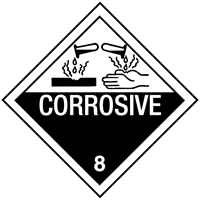
DOT Hazard Label |
USCG CHRIS Code |
|
|
|
|
|
| NIOSH Pocket Guide |
International Chem Safety Card |
|
none
|
- FERRIC CHLORIDE (ANHYDROUS)
|
NFPA 704
data unavailable
General Description
Ferric chloride is an orange to brown-black solid. It is slightly soluble in water. It is noncombustible. When wet it is corrosive to aluminum and most metals. Pick up and remove spilled solid before adding water. It is used to treat sewage, industrial waste, to purify water, as an etching agent for engraving circuit boards, and in the manufacture of other chemicals.
Hazards
Reactivity Alerts
Air & Water Reactions
Very hygroscopic. Slightly water soluble, where a 0.1M solution has a pH of 2.0.
Fire Hazard
Special Hazards of Combustion Products: Irritating hydrogen chloride fumes may form in fire. (USCG, 1999)
Health Hazard
Inhalation of dust may irritate nose and throat. Ingestion causes irritation of mouth and stomach. Dust irritates eyes. Prolonged contact with skin causes irritation and burns. (USCG, 1999)
Reactivity Profile
Anhydrous iron chloride may catalyze the rearrangement and polymerization of ethylene oxide, liberating heat [J. Soc. Chem. Ind. 68:179(1949)]. Allyl chloride may polymerize violently under conditions involving an acid catalyst, including ferric chloride [Ventrone (1971)].
Belongs to the Following Reactive Group(s)
- Acids, Strong Non-oxidizing
Potentially Incompatible Absorbents
No information available.
Response Recommendations
Isolation and Evacuation
Excerpt from 157

[Substances - Toxic and/or Corrosive (Non-Combustible / Water-Sensitive)]:
IMMEDIATE PRECAUTIONARY MEASURE: Isolate spill or leak area in all directions for at least 50 meters (150 feet) for liquids and at least 25 meters (75 feet) for solids.
SPILL: Increase the immediate precautionary measure distance, in the downwind direction, as necessary.
FIRE: If tank, rail car or tank truck is involved in a fire, ISOLATE for 800 meters (1/2 mile) in all directions; also, consider initial evacuation for 800 meters (1/2 mile) in all directions. (ERG, 2020)
Firefighting
Excerpt from 157
[Substances - Toxic and/or Corrosive (Non-Combustible / Water-Sensitive)]:
Note: Some foams will react with the material and release corrosive/toxic gases.
SMALL FIRE: CO2 (except for Cyanides), dry chemical, dry sand, alcohol-resistant foam.
LARGE FIRE: Water spray, fog or alcohol-resistant foam. If it can be done safely, move undamaged containers away from the area around the fire. Avoid aiming straight or solid streams directly onto the product. Dike runoff from fire control for later disposal.
FIRE INVOLVING TANKS OR CAR/TRAILER LOADS: Fight fire from maximum distance or use unmanned master stream devices or monitor nozzles. Do not get water inside containers. Cool containers with flooding quantities of water until well after fire is out. Withdraw immediately in case of rising sound from venting safety devices or discoloration of tank. ALWAYS stay away from tanks engulfed in fire. (ERG, 2020)
Non-Fire Response
Excerpt from 157
[Substances - Toxic and/or Corrosive (Non-Combustible / Water-Sensitive)]:
ELIMINATE all ignition sources (no smoking, flares, sparks or flames) from immediate area. All equipment used when handling the product must be grounded. Do not touch damaged containers or spilled material unless wearing appropriate protective clothing. Stop leak if you can do it without risk. A vapor-suppressing foam may be used to reduce vapors. DO NOT GET WATER INSIDE CONTAINERS. Use water spray to reduce vapors or divert vapor cloud drift. Avoid allowing water runoff to contact spilled material. Prevent entry into waterways, sewers, basements or confined areas.
SMALL SPILL: Cover with DRY earth, DRY sand or other non-combustible material followed with plastic sheet to minimize spreading or contact with rain. Use clean, non-sparking tools to collect material and place it into loosely covered plastic containers for later disposal. (ERG, 2020)
Protective Clothing
Dust respirator if required; rubber apron and boots; chemical worker's goggles or face shield (USCG, 1999)
DuPont Tychem® Suit Fabrics
Normalized Breakthrough Times (in Minutes)
| Chemical |
CAS Number |
State |
QS |
QC |
SL |
C3 |
TF |
TP |
RC |
TK |
RF |
| Ferric (III) chloride (40%) |
7705-08-0 |
Liquid |
|
|
|
|
>480 |
|
|
|
|
| Ferric (III) chloride (50%) |
7705-08-0 |
Liquid |
|
|
>480 |
|
|
|
>480 |
|
|
Special Warning from DuPont: Tychem® and Tyvek® fabrics should not be
used around heat, flames, sparks or in potentially flammable or
explosive environments. Only...
(DuPont, 2023)
First Aid
EYES: First check the victim for contact lenses and remove if present. Flush victim's eyes with water or normal saline solution for 20 to 30 minutes while simultaneously calling a hospital or poison control center. Do not put any ointments, oils, or medication in the victim's eyes without specific instructions from a physician. IMMEDIATELY transport the victim after flushing eyes to a hospital even if no symptoms (such as redness or irritation) develop.
SKIN: IMMEDIATELY flood affected skin with water while removing and isolating all contaminated clothing. Gently wash all affected skin areas thoroughly with soap and water. IMMEDIATELY call a hospital or poison control center even if no symptoms (such as redness or irritation) develop. IMMEDIATELY transport the victim to a hospital for treatment after washing the affected areas.
INHALATION: IMMEDIATELY leave the contaminated area; take deep breaths of fresh air. If symptoms (such as wheezing, coughing, shortness of breath, or burning in the mouth, throat, or chest) develop, call a physician and be prepared to transport the victim to a hospital. Provide proper respiratory protection to rescuers entering an unknown atmosphere. Whenever possible, Self-Contained Breathing Apparatus (SCBA) should be used; if not available, use a level of protection greater than or equal to that advised under Protective Clothing.
INGESTION: DO NOT INDUCE VOMITING. Corrosive chemicals will destroy the membranes of the mouth, throat, and esophagus and, in addition, have a high risk of being aspirated into the victim's lungs during vomiting which increases the medical problems. If the victim is conscious and not convulsing, give 1 or 2 glasses of water to dilute the chemical and IMMEDIATELY call a hospital or poison control center. IMMEDIATELY transport the victim to a hospital. If the victim is convulsing or unconscious, do not give anything by mouth, ensure that the victim's airway is open and lay the victim on his/her side with the head lower than the body. DO NOT INDUCE VOMITING. Transport the victim IMMEDIATELY to a hospital. (NTP, 1992)
Physical Properties
Flash Point: data unavailable
Lower Explosive Limit (LEL): data unavailable
Upper Explosive Limit (UEL): data unavailable
Autoignition Temperature: data unavailable
Melting Point:
583°F
(NTP, 1992)
Vapor Pressure:
1 mmHg
at 381°F
(NTP, 1992)
Vapor Density (Relative to Air): data unavailable
Specific Gravity:
2.8
at 68°F
(anhydrous solid)
(USCG, 1999)
- Denser than water; will sink
Boiling Point:
599°F
at 760 mmHg
(Decomposes)
(NTP, 1992)
Molecular Weight:
162.2
(NTP, 1992)
Water Solubility:
5 to 10 mg/mL
at 68°F
(NTP, 1992)
Ionization Energy/Potential: data unavailable
IDLH: data unavailable
AEGLs (Acute Exposure Guideline Levels)
No AEGL information available.
ERPGs (Emergency Response Planning Guidelines)
No ERPG information available.
PACs (Protective Action Criteria)
| Chemical |
PAC-1 |
PAC-2 |
PAC-3 |
| Ferric chloride (7705-08-0)
|
8.7 mg/m3 |
30 mg/m3 |
180 mg/m3 |
(DOE, 2018)
Regulatory Information
EPA Consolidated List of Lists
| Regulatory Name |
CAS Number/
313 Category Code |
EPCRA 302
EHS TPQ |
EPCRA 304
EHS RQ |
CERCLA RQ |
EPCRA 313
TRI |
RCRA
Code |
CAA 112(r)
RMP TQ |
| Ferric chloride |
7705-08-0 |
|
|
1000 pounds |
|
|
|
(EPA List of Lists, 2022)
CISA Chemical Facility Anti-Terrorism Standards (CFATS)
No regulatory information available.
OSHA Process Safety Management (PSM) Standard List
No regulatory information available.
Alternate Chemical Names
- CLAYFEC
- FECL3: FERRIC CHLORIDE, IRON(III) CHLORIDE
- FERRIC CHLORIDE
- FERRIC CHLORIDE, ANHYDROUS
- FERRIC CHLORIDE, HEXAHYDRATE
- FERRIC CHLORIDE, [SOLID, ANHYDROUS]
- FERRIC TRICHLORIDE
- FLORES MARTIS
- IRON (III) CHLORIDE
- IRON CHLORIDE
- IRON III CHLORIDE
- IRON PERCHLORIDE
- IRON TRICHLORIDE
- IRON(III) CHLORIDE
- TRIFLOC