
 Print
Print
Chemical Datasheet
AMINOPTERIN |
|
Chemical Identifiers
| CAS Number |
UN/NA Number |
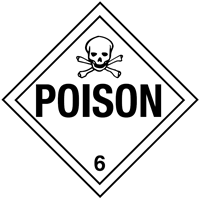
DOT Hazard Label |
USCG CHRIS Code |
|
|
|
|
none
|
| NIOSH Pocket Guide |
International Chem Safety Card |
|
none
|
none
|
NFPA 704
data unavailable
General Description
Clusters of yellow needles. Used as a rodenticide, medicine and rodenticide. Not registered as a rodenticide in the U.S. (EPA, 1998)
Hazards
Reactivity Alerts
none
Air & Water Reactions
No rapid reaction with air. No rapid reaction with water.
Fire Hazard
Excerpt from 154

[Substances - Toxic and/or Corrosive (Non-Combustible)]:
Non-combustible, substance itself does not burn but may decompose upon heating to produce corrosive and/or toxic fumes. Some are oxidizers and may ignite combustibles (wood, paper, oil, clothing, etc.). Contact with metals may evolve flammable hydrogen gas. Containers may explode when heated. For electric vehicles or equipment, 147
(lithium ion batteries) or 138
(sodium batteries) should also be consulted. (ERG, 2020)
Health Hazard
An antimetabolite; antagonizes the utilization of folic acid by the body. Highly toxic by ingestion. (EPA, 1998)
Reactivity Profile
It is an amino derivative of folic acid.
Belongs to the Following Reactive Group(s)
- Acids, Carboxylic
- Amides and Imides
- Amines, Phosphines, and Pyridines
- Hydrocarbons, Aliphatic Unsaturated
Potentially Incompatible Absorbents
Use caution: Liquids with this reactive group classification have been
known to react with the
absorbents
listed below.
- Mineral-Based & Clay-Based Absorbents
- Dirt/Earth
Response Recommendations
Isolation and Evacuation
Excerpt from 154
[Substances - Toxic and/or Corrosive (Non-Combustible)]:
IMMEDIATE PRECAUTIONARY MEASURE: Isolate spill or leak area in all directions for at least 50 meters (150 feet) for liquids and at least 25 meters (75 feet) for solids.
SPILL: Increase the immediate precautionary measure distance, in the downwind direction, as necessary.
FIRE: If tank, rail car or tank truck is involved in a fire, ISOLATE for 800 meters (1/2 mile) in all directions; also, consider initial evacuation for 800 meters (1/2 mile) in all directions. (ERG, 2020)
Firefighting
Excerpt from 154
[Substances - Toxic and/or Corrosive (Non-Combustible)]:
SMALL FIRE: Dry chemical, CO2 or water spray.
LARGE FIRE: Dry chemical, CO2, alcohol-resistant foam or water spray. If it can be done safely, move undamaged containers away from the area around the fire. Dike runoff from fire control for later disposal.
FIRE INVOLVING TANKS OR CAR/TRAILER LOADS: Fight fire from maximum distance or use unmanned master stream devices or monitor nozzles. Do not get water inside containers. Cool containers with flooding quantities of water until well after fire is out. Withdraw immediately in case of rising sound from venting safety devices or discoloration of tank. ALWAYS stay away from tanks engulfed in fire. (ERG, 2020)
Non-Fire Response
(Non-Specific -- Pesticide, Solid, n.o.s.) Do not touch spilled material; stop leak if you can do so without risk. Use water spray to reduce vapors.
Small spills: absorb with sand or other noncombustible absorbent material and place into containers for later disposal.
Small dry spills: with clean shovel place material into clean, dry container and cover; move containers from spill area.
Large spills: dike far ahead of spill for later disposal. (EPA, 1998)
Protective Clothing
For emergency situations, wear a positive pressure, pressure-demand, full facepiece self-contained breathing apparatus (SCBA) or pressure- demand supplied air respirator with escape SCBA and a fully-encapsulating, chemical resistant suit. (EPA, 1998)
DuPont Tychem® Suit Fabrics
No information available.
First Aid
Signs and Symptoms of Aminopterin Exposure: Signs and symptoms of acute exposure to aminopterin may include nausea, vomiting, anorexia, stomatitis (inflammation of the oral mucosa), pharyngitis (inflammation of the pharynx), erythematous rashes (red rashes on the skin), hyperpigmentation (abnormally increased pigmentation), chills, fever, gastrointestinal hemorrhage, and renal failure (especially in high doses). May induce abortion in pregnant women.
Emergency Life-Support Procedures: Acute exposure to aminopterin may require decontamination and life support for the victims. Emergency personnel should wear protective clothing appropriate to the type and degree of contamination. Air-purifying or supplied-air respiratory equipment should also be worn, as necessary. Rescue vehicles should carry supplies such as plastic sheeting and disposable plastic bags to assist in preventing spread of contamination.
Inhalation Exposure:
1. Move victims to fresh air. Emergency personnel should avoid self-exposure to aminopterin.
2. Evaluate vital signs including pulse and respiratory rate, and note any trauma. If no pulse is detected, provide CPR. If not breathing, provide artificial respiration. If breathing is labored, administer 100% humidified oxygen or other respiratory support.
3. Obtain authorization and/or further instructions from the local hospital for performance of other invasive procedures.
4. Transport to a health care facility.
Dermal/Eye Exposure:
1. Remove victims from exposure. Emergency personnel should avoid self-exposure to aminopterin.
2. Evaluate vital signs including pulse and respiratory rate, and note any trauma. If no pulse is detected, provide CPR. If not breathing, provide artificial respiration. If breathing is labored, administer 100% humidified oxygen or other respiratory support.
3. Remove contaminated clothing as soon as possible.
4. If eye exposure has occurred, eyes must be flushed with lukewarm water for at least 15 minutes.
5. Wash exposed skin areas thoroughly with water.
6. Obtain authorization and/or further instructions from the local hospital for performance of other invasive procedures.
7. Transport to a health care facility.
Ingestion Exposure:
1. Evaluate vital signs including pulse and respiratory rate, and note any trauma. If no pulse is detected, provide CPR. If not breathing, provide artificial respiration. If breathing is labored, administer 100% humidified oxygen or other respiratory support to all victims.
2. Obtain authorization and/or further instructions from the local hospital for administration of an antidote or performance of other invasive procedures.
3. Vomiting may be induced with syrup of Ipecac. If elapsed time since ingestion of aminopterin is unknown or suspected to be greater than 30 minutes, do not induce vomiting and proceed to Step
4. Ipecac should not be administered to children under 6 months of age.Warning: Syrup of Ipecac should be administered only if victims are alert, have an active gag-reflex, and show no signs of impending seizure or coma. If ANY uncertainty exists, proceed to Step
4.The following dosages of Ipecac are recommended: children up to 1 year old, 10 mL (1/3 oz); children 1 to 12 years old, 15 mL (1/2 oz); adults, 30 mL (1 oz). Ambulate (walk) the victims and give large quantities of water. If vomiting has not occurred after 15 minutes, Ipecac may be readministered. Continue to ambulate and give water to the victims. If vomiting has not occurred within 15 minutes after second administration of Ipecac, administer activated charcoal.
4. Repeated oral charcoal doses may enhance total body clearance and elimination. Activated charcoal may be administered if victims are conscious and alert. Use 15 to 30 g (1/2 to 1 oz) for children, 50 to 100 g (1-3/4 to 3-1/2 oz) for adults, with 125 to 250 mL (1/2 to 1 cup) of water.
5. Promote excretion by administering a saline cathartic or sorbitol to conscious and alert victims. Children require 15 to 30 g (1/2 to 1 oz) of cathartic; 50 to 100 g (1-3/4 to 3-1/2 oz) is recommended for adults. A saline cathartic or sorbitol may be given with the first charcoal dose.
6. Transport to a health care facility. (EPA, 1998)
Physical Properties
Flash Point: data unavailable
Lower Explosive Limit (LEL): data unavailable
Upper Explosive Limit (UEL): data unavailable
Autoignition Temperature: data unavailable
Melting Point: data unavailable
Vapor Pressure: data unavailable
Vapor Density (Relative to Air): data unavailable
Specific Gravity: data unavailable
Boiling Point: data unavailable
Molecular Weight:
440.47
(EPA, 1998)
Water Solubility: data unavailable
Ionization Energy/Potential: data unavailable
IDLH: data unavailable
AEGLs (Acute Exposure Guideline Levels)
No AEGL information available.
ERPGs (Emergency Response Planning Guidelines)
No ERPG information available.
PACs (Protective Action Criteria)
No PAC information available.
Regulatory Information
EPA Consolidated List of Lists
| Regulatory Name |
CAS Number/
313 Category Code |
EPCRA 302
EHS TPQ |
EPCRA 304
EHS RQ |
CERCLA RQ |
EPCRA 313
TRI |
RCRA
Code |
CAA 112(r)
RMP TQ |
| Aminopterin |
54-62-6 |
500/10000 pounds |
500 pounds |
|
|
|
|
(EPA List of Lists, 2022)
CISA Chemical Facility Anti-Terrorism Standards (CFATS)
No regulatory information available.
OSHA Process Safety Management (PSM) Standard List
No regulatory information available.
Alternate Chemical Names
- A-NINOPTERIN
- 4-AMINO-4-DEOXYPTEROYLGLUTAMATE
- 4-AMINO-PGA
- 4-AMINOFOLIC ACID
- AMINOPTERIDINE
- AMINOPTERIN
- AMINOPTERINE
- 4-AMINOPTEROYLGLUTAMIC ACID
- APGA
- ENT-26079
- FOLIC ACID, 4-AMINO-
- GLUTAMIC ACID, N-(P-(((2,4-DIAMINO-6-PTERIDINYL)METHYL)AMINO)BENZOYL)-, L-
- GLUTAMIC ACID, N-[P-[[(2,4-DIAMINO-6-PTERIDINYL)METHYL]AMINO]BENZOYL]-, L-
- L-GLUTAMIC ACID, N-[4-[(DIAMINO-6-PTERIDINYL)METHYL] AMINO]BENZOYL]-
- N-(4-((2,4-DIAMINO-6- PTERIDINYL)METHYL)AMINO)BENZOYL)-L-GLUTAMIC ACID
- NSC 739
- PTERAMINA