
 Print
Print
Chemical Datasheet
SULFUR, MOLTEN |
|
Chemical Identifiers
| CAS Number |
UN/NA Number |
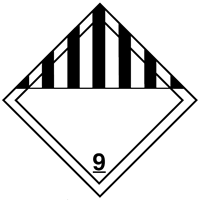
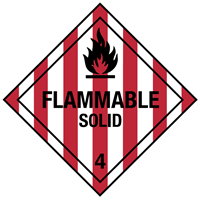
DOT Hazard Label |
USCG CHRIS Code |
|
|
|
- Class 9 (domestic)
- Flammable Solid (international)
|
|
| NIOSH Pocket Guide |
International Chem Safety Card |
|
none
|
|
NFPA 704
General Description
A pale yellow crystalline solid with a faint odor of rotten eggs. Insoluble in water. A fire and explosion risk above 450°F. Transported as a yellow to red liquid. Handled at elevated temperature (typically 290°F) to prevent solidification and makes transfers easier. Hot enough that plastic or rubber may melt or lose strength. Causes thermal burns to skin on contact. Cools rapidly and solidifies if released. Equipment designed to protect against ordinary chemical exposure is ineffective against the thermal hazard. Exercise caution walking on the surface of a spill to avoid breakthrough into pockets of molten sulfur below the crust. Do not attempt to remove sulfur impregnated clothing because of the danger of tearing flesh if a burn has resulted. May be irritatin to skin, eyes and mucous membranes. Used in sulfuric acid production, petroleum refining, and pulp and paper manufacturing.
Hazards
Reactivity Alerts
- Highly Flammable
- Strong Reducing Agent
Air & Water Reactions
Flammable. Insoluble in water.
Fire Hazard
Special Hazards of Combustion Products: Produces toxic sulfur dioxide gas.
Behavior in Fire: Burns with a pale blue flame that may be difficult to see in daylight. (USCG, 1999)
Health Hazard
Can cause eye irritation; may rarely irritate skin. If recovered sulfur, refer to hydrogen sulfide.* (USCG, 1999)
Reactivity Profile
SULFUR reacts violently with strong oxidizing agents causing fire and explosion hazards [Handling Chemicals Safely 1980 p. 871]. Reacts with iron to give pyrophoric compounds. Attacks copper, silver and mercury. Reacts with bromine trifluoride, even at 10°C [Mellor 2:113. 1946-47]. Ignites in fluorine gas at ordinary temperatures [Mellor 2:11-13 1946-47]. Reacts to incandescence with heated with thorium [Mellor 7:208 1946-47]. Can react with ammonia to form explosive sulfur nitride. Reacts with calcium phosphide incandescently at about 300°C. Reacts violently with phosphorus trioxide [Chem. Eng. News 27:2144 1949]. Mixtures with ammonium nitrate or with metal powders can be exploded by shock [Kirk and Othmer 8:644]. Combinations of finely divided sulfur with finely divided bromates, chlorates, or iodates of barium, calcium, magnesium, potassium, sodium, or zinc can explode with heat, friction, percussion, and sometimes light [Mellor 2 Supp.1:763. 1956]. A mixture with barium carbide heated to 150°C becomes incandescent. Reacts incandescently with calcium carbide or strontium carbide at 500°C. Attacks heated lithium, or heated selenium carbide with incandescence [Mellor 5:862 1946-47]. Reacts explosively if warmed with powdered zinc [Mellor 4:476. 1946-47]. Reacts vigorously with tin [Mellor 7:328. 1946-47]. A mixture with potassium nitrate and arsenic trisulfide is a known pyrotechnic formulation [Ellern 1968 p. 135]. Mixtures with any perchlorate can explode on impact [ACS 146:211-212]. A mixture of damp sulfur and calcium hypochlorite produces a brilliant crimson flash with scatter of molten sulfur [Chem. Eng. News 46(28):9 1968]. Takes fire spontaneously in chlorine dioxide and may produce an explosion [Mellor 2:289 (1946-47)]. Ignites if heated with chromic anhydride ignite and can explode, [Mellor 10:102 (1946-47)]. Even small percentages of hydrocarbons in contact with molten sulfur generate hydrogen sulfide and carbon disulfide, which may accumulate in explosive concentrations. Sulfur reacts with Group I metal nitrides to form flammable mixtures, evolving flammable and toxic NH3 and H2S gases if water is present (Mellor, 1940, Vol. 8, 99).
Belongs to the Following Reactive Group(s)
Potentially Incompatible Absorbents
No information available.
Response Recommendations
Isolation and Evacuation
Excerpt from 133

[Flammable Solids]:
IMMEDIATE PRECAUTIONARY MEASURE: Isolate spill or leak area for at least 25 meters (75 feet) in all directions.
LARGE SPILL: Consider initial downwind evacuation for at least 100 meters (330 feet).
FIRE: If tank, rail car or tank truck is involved in a fire, ISOLATE for 800 meters (1/2 mile) in all directions; also, consider initial evacuation for 800 meters (1/2 mile) in all directions. (ERG, 2020)
Firefighting
Excerpt from 133
[Flammable Solids]:
SMALL FIRE: Dry chemical, CO2, sand, earth, water spray or regular foam.
LARGE FIRE: Water spray, fog or regular foam. If it can be done safely, move undamaged containers away from the area around the fire. Fire Involving Metal Pigments or Pastes (e.g. "Aluminum Paste") Aluminum Paste fires should be treated as a combustible metal fire. Use DRY sand, graphite powder, dry sodium chloride-based extinguishers or class D extinguishers. Also, see 170
.
FIRE INVOLVING TANKS OR CAR/TRAILER LOADS: Cool containers with flooding quantities of water until well after fire is out. For massive fire, use unmanned master stream devices or monitor nozzles; if this is impossible, withdraw from area and let fire burn. Withdraw immediately in case of rising sound from venting safety devices or discoloration of tank. ALWAYS stay away from tanks engulfed in fire. (ERG, 2020)
Non-Fire Response
Excerpt from 133
[Flammable Solids]:
ELIMINATE all ignition sources (no smoking, flares, sparks or flames) from immediate area. Do not touch or walk through spilled material.
SMALL DRY SPILL: With clean shovel, place material into clean, dry container and cover loosely; move containers from spill area.
LARGE SPILL: Wet down with water and dike for later disposal. Prevent entry into waterways, sewers, basements or confined areas. (ERG, 2020)
Protective Clothing
Safety goggles with side shields; approved respirator; heat-resistant gloves; leather heat-resistant clothing. If recovered sulfur, refer to hydrogen sulfide.* (USCG, 1999)
DuPont Tychem® Suit Fabrics
No information available.
First Aid
EYES: wash eyes carefully for at least 15 min.
SKIN: Treat molten sulfur burns with petroleum jelly or mineral oil. If recovered sulfur, treat as for hydrogen sulfide.* (USCG, 1999)
Physical Properties
Flash Point:
405°F
(USCG, 1999)
Lower Explosive Limit (LEL): data unavailable
Upper Explosive Limit (UEL): data unavailable
Autoignition Temperature:
450°F
(USCG, 1999)
Melting Point:
251°F
(USCG, 1999)
Vapor Pressure: data unavailable
Vapor Density (Relative to Air): data unavailable
Specific Gravity:
1.8
at 248°F
(USCG, 1999)
- Denser than water; will sink
Boiling Point:
832.3°F
at 760 mmHg
(USCG, 1999)
Molecular Weight:
256.51
(USCG, 1999)
Water Solubility: data unavailable
Ionization Energy/Potential: data unavailable
IDLH: data unavailable
AEGLs (Acute Exposure Guideline Levels)
No AEGL information available.
ERPGs (Emergency Response Planning Guidelines)
No ERPG information available.
PACs (Protective Action Criteria)
No PAC information available.
Regulatory Information
EPA Consolidated List of Lists
No regulatory information available.
CISA Chemical Facility Anti-Terrorism Standards (CFATS)
No regulatory information available.
OSHA Process Safety Management (PSM) Standard List
No regulatory information available.
Alternate Chemical Names
- BRIMSTONE
- SULFUR
- SULFUR, DRY
- SULFUR, MOLTEN
- SULFUR, [MOLTEN]
- SULFUR, [SOLID]
- SULPHUR
- SULPHUR, MOLTEN
 Health
 Flammability
 Instability
 Special